
YouTube in AI: How the world’s AI engines are learning to recommend video
By Jack Smyth, Country Lead, Australia — The Brandtech Group
July 2026
Search isn’t being replaced. It’s getting better at understanding what people actually want. More of the questions people used to turn into keywords are now asked in plain language — and answered directly, with sources attached. That’s an evolution of search, not an exit from it.
But in that answer, not every source carries the same weight. A paragraph of text tells an AI what a brand claims. A video can show it — a comparison, a demonstration, a walkthrough — and hand the AI something far richer to work with: a transcript, a spoken explanation, chapters, a specific moment that answers a specific question. That difference is quietly reshaping which sources AI reaches for first.
We’ve spent the past three years studying exactly which sources AI reaches for: across industries, markets and models. Analysing the answer patterns for millions of unique, local prompts for everything from everyday purchases to life-defining financial decisions. One result keeps repeating, market after market, category after category.
YouTube is the platform AI recommends most.
Not occasionally, and not in one or two categories — consistently, and increasingly, everywhere we look.
Wider than anything else
Across everything we’ve measured — cars, skincare, banking, cleaning products, chocolate, consumer electronics — there is exactly one video or social platform that shows up in every single category: YouTube. TikTok might dominate a beauty question and disappear from a finance one. Instagram can lead in fashion and vanish in insurance. YouTube doesn’t disappear.
Overall, YouTube appears in more than 1 in 4 AI-generated answers across the categories we track — and in the categories people research hardest, like electronics and household goods, that climbs to nearly 1 in 2. In Australian financial services, YouTube is now cited by AI more often than every one of the country’s four biggest banks individually — a platform with no accounts, no interest rates and no banking licence, simply out-cited on usefulness.
No brand plans for a video platform to become a competitor to its own bank, or its own retailer. That is what breadth means now.
Present at every stage, not just the start
Breadth is only half of it. The more interesting finding is depth — how far YouTube follows someone through an actual decision, rather than fading once the browsing turns serious.
In a detailed study of nearly 1,900 real questions about loans, credit cards, savings and insurance, YouTube showed up in about half of AI answers while people were still comparing their options — and in more than a third of AI answers once people were actually making the decision: refinancing a mortgage, opening an account, choosing a policy. Most channels fade as a purchase gets closer. YouTube gets more useful, not less.
The case for length
Part of the reason is what a long video actually contains. A twelve-minute comparison video has a transcript, chapters, spoken detail, and often the presenter’s own testing — far more for an AI to work with than a paragraph of marketing copy.
We looked directly at the YouTube links AI engines cited across three separate research projects — American car buyers, Australian skincare shoppers, and Australian households comparing cleaning products — more than 1,500 individual video citations in total. Roughly three out of every four were ordinary long-form videos. Only one in four were Shorts.
It gets more precise than that. About one in seven of those long-form citations didn’t just point to a video — they pointed to an exact moment inside it, down to the second. The AI had, in effect, watched the video, found the part that actually answered the question, and sent the person straight there.
None of this makes Shorts or brand content pointless — quite the opposite. Shorts are how most people discover a channel in the first place, and a channel that never posts one is often invisible to the audience that would eventually watch the long video. The strongest performers we see run all three together: a thorough long-form video with something specific for an AI to find, Shorts that build the audience who’ll go looking for it, and brand content that shows up around both. Length gives you something to be cited for. Shorts give you an audience to be found by.
What actually gets cited
Knowing that YouTube gets cited is one thing. Knowing what kind of video earns that citation is more useful. So we went a step further and opened the actual videos AI was linking to — around thirty of them, across three different industries — and looked at what they had in common: how old they were, how long they ran, how many views and subscribers stood behind them, and what they were actually about.
The clearest pattern is in the subject line, not the channel name. The videos AI cites are overwhelmingly comparisons (“X vs Y”), dated reviews (“App Review 2026”), and buying guides (“Best of”, “Top 5”). They are structured like an answer before an AI ever touches them — a clear question in the title, a direct verdict in the video. Lifestyle content, brand storytelling and general chat almost never made the cut.
Followers matter far less than expected. In our sample, a video from a channel with 84,500 subscribers and a video from a channel with a few hundred lifetime views were both being cited for the same kind of question. View counts told a similar story: some cited videos had racked up close to 200,000 views, others barely a few hundred. What the cited videos shared wasn’t audience size — it was a title and structure that mapped directly onto a real question.
Length followed the question, not a formula. A dense, sixteen-minute comparison earned a citation in financial services; a two-minute demonstration earned one in household cleaning. Neither is “more right.” The video simply needs to be as long as the answer requires and no longer.
Recency is where the pattern really splits — and it splits by industry, not by chance.
Same platform, different playbook
To see how differently this plays out, we lined up three industries with very different products, buying cycles and content histories: financial services, consumer electronics, and household and grocery goods (CPG). Same platform, same measurement, three distinct patterns.
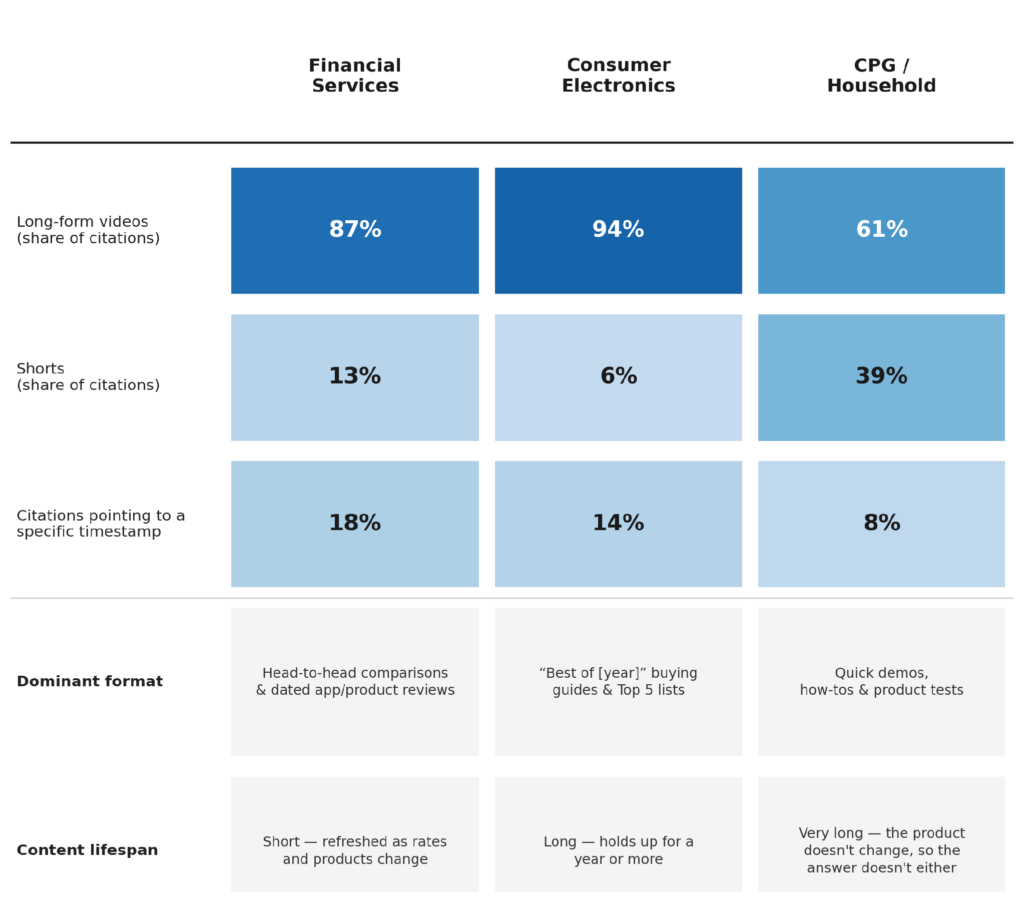
Financial services leans hardest on long-form and is the category most likely to send someone to an exact timestamp — dense comparison content that needs a guide, and a guide that needs upkeep as rates and products move. Consumer electronics leans even harder into long-form, and it’s the one category where YouTube’s citations rank consistently near the top of all AI-cited sources, not just present among them — because a well-built “best of” list keeps answering the same question for a year or more. CPG is the outlier in the other direction: Shorts do real work here, timestamps barely matter because the video is already short enough to be the answer, and a two-year-old stain-remover demo can still be pulling views most brand campaigns would envy, because the product hasn’t changed and neither has the answer.
The takeaway isn’t “make more YouTube content.” It’s that the right YouTube content is different in every category. A finance brand chasing a viral, 30-second Short is optimising for the wrong format. A cleaning brand commissioning a 20-minute deep dive is making the same mistake in reverse. The brief has to start with what AI is already citing in your category — not with what worked for the category next door.
AI already found the good part
Without anyone deciding it should, a brand’s YouTube plan has quietly become its AI answer plan too. That timestamp finding — AI pointing to a specific minute inside a video — is more than a curiosity. It’s a shortlist.
If an AI engine is sending people to the fourth minute of a video because that is where the real answer lives, that four-minute segment has effectively already been tested — by the AI itself — as the single most useful part of the video. That isn’t a guess about what to promote. It’s a verified answer.
Being cited is one thing. Being amplified is another — and most brands are only doing the first.
YouTube now has an ad format built for almost exactly this moment. Creator Partnerships lets a brand take an existing creator video — the organic one already earning attention, and quite possibly already earning AI citations — and turn it directly into a paid in-stream or Shorts ad, with no new shoot and no new brief. Early testing shows ads built this way convert around 30% better than a standard ad, because the audience already trusts the voice delivering it.
Put the two together and you get a genuinely new way to plan media: don’t guess which clip to boost. Cut the clip AI already pointed to, and put spend behind exactly that.
A return that keeps paying you back
There is a broader shift underneath all of this. A paid ad works while the budget is running, and stops the moment it isn’t. A well-made YouTube video keeps working — people keep watching it, and increasingly, AI keeps citing it — for as long as it stays accurate and useful, without any extra spend. Early data puts the long-term return from creator content at more than double a typical paid social campaign for the same money.
That is not an argument for leaving a four-year-old video running forever and hoping nobody notices the out-of-date price. Stale information erodes trust — with a person watching, and with an AI reading. The better way to think about it: treat your best long-form videos as an asset to maintain, not a campaign to fire and forget. Keep the facts current, and every extra month a good video keeps earning attention and citations is a month you didn’t have to buy that reach all over again. No other platform — social or search — currently compounds quite this way, for a human audience and an AI one at the same time.
Where to start
None of this requires a new department or a new platform. It requires treating YouTube as what it has become: not a channel you fill, but infrastructure your brand is already being measured against.
The right question isn’t “are we on YouTube?” It’s “do we know which of our videos AI is already recommending — and are we doing anything about it?”
Three places to start. Find out which videos are already being recommended by AI in your category — yours and everyone else’s — before you brief a single new one. Favour long, thorough videos over quick ones whenever the goal is to answer a real question, and keep a steady flow of Shorts and brand content around them so people find their way in. And when a long video earns real attention, from people or from AI, look at boosting the exact part that’s working rather than starting from scratch on the next brief.
The brands that worked this out about search twenty years ago built a durable advantage. The same window is open now, and it’s shorter than the last one.
Jack Smyth
Country Lead, Australia
The Brandtech Group
METHODOLOGY
This paper draws on three sources. The first is Share of Model, a proprietary measurement system built by The Brandtech Group in 2023 that tracks how AI systems answer real consumer questions. The 30% conversion-lift figure and the long-term return figure are drawn from Google and Kantar’s own reporting on YouTube Creator Partnerships and creator content performance (2026).